🧵 The Story of Sweaters Rooted in Regional Traditions and Brands
- Tony Han
- Dec 11, 2025
- 4 min read

Sweaters go beyond being simple knitwear for warmth in winter. They represent a fashion heritage shaped by each region’s climate, lifestyle, cultural symbols, and access to fibers. Today, let’s explore some of the world’s most famous sweater types, their historical backgrounds, design features, and how modern brands continue their legacy.
1) 🟦 Fair Isle Sweater
The Fair Isle sweater, also called the Shetland sweater, originated in Scotland’s Shetland Islands. Traditionally made of 100% Shetland wool or blends, it is lightweight, traps air for insulation, and features a dry, slightly hairy texture rather than smoothness. The name comes from Fair Isle, a small island in the North Sea. Its design is believed to have been influenced by Norwegian knitting in the 1500s. The hallmark is stranded colorwork using 2–3 colors at once, forming repeating geometric bands.


The sweater gained global popularity in 1922 when the Prince of Wales wore it publicly, cementing its place as a British fashion icon. Celebrities and style icons later embraced it, spreading its influence worldwide. Fair Isle sweaters embody the harsh North Sea climate—warm, practical, and infused with the craftsmanship of island communities. A unique feature of originals is the protruding floats on the inside of the sweater.


2) 🟩 Shaggy Dog Sweater
The Shaggy Dog sweater refers to a brushed finishing technique that creates a fuzzy surface resembling a dog’s fur. Originating in Britain, it became commercialized in the U.S. by J. Press, who used teaseling—a process involving the teasel plant—to raise fibers on solid-colored Shetland sweaters.
Teaseling lifts short fibers to create a soft, fluffy nap, often used in high-end knitwear finishing. The result is a sweater that feels warm, light, and cozy. This style emerged in the 1950s as a texture trend, inspired by naturally worn sweaters with fuzz and pilling. Modern brands like Harley of Scotland continue to produce Shaggy Dog textures, highlighting both practicality and aesthetics.


3) 🟨 Fisherman / Guernsey Sweater
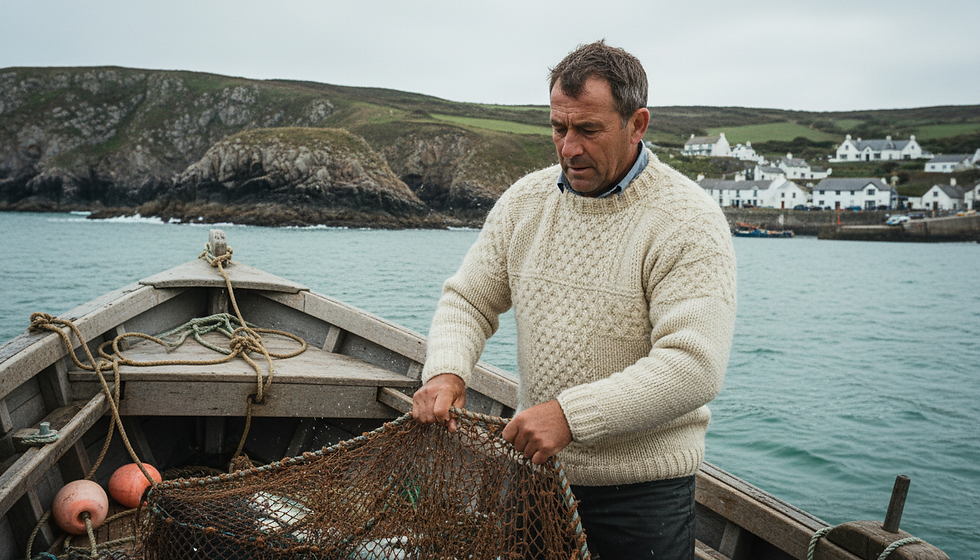
The Guernsey sweater, with over 400 years of history, originated on Guernsey Island in the English Channel as fishermen’s workwear. Its dense gauge provides durability and wind resistance, while rope and wave motifs symbolize maritime life.
French fishermen adapted the design, adding stripes and shoulder buttons for easier wear. Today, British brands like Guernsey Woollens preserve the original, while French brands such as ORCIVAL, SAINT JAMES, and ARMOR-LUX carry on the tradition. The Guernsey sweater embodies both functionality and cultural symbolism.


4) 🟧 Aran Sweater
The Aran sweater comes from Ireland’s Aran Islands. Developed in the late 19th to early 20th century, it was commercialized to support local livelihoods. Unlike other sweaters born purely from necessity, Aran sweaters were intentionally designed for sale.
Their hallmark is textured stitches—cables, honeycombs, diamonds—woven into the fabric itself, symbolizing community, prosperity, and safety. Unprocessed wool was used, offering warmth and water resistance even when wet. Brands like Aran Craft and Blarney Woollen Mills continue to produce these iconic patterns, making Aran sweaters a cornerstone of Ireland’s knitwear exports.

5) 🟪 Cowichan Sweater
The Cowichan sweater originated with the Coast Salish people of Vancouver Island, Canada, after European settlers introduced knitting. Hand-knit by Indigenous women, it features thick, unspun wool, bold motifs inspired by nature (deer, bears, totems), and strong color contrasts.
Traditionally, qiviut (musk ox wool) was used—softer and warmer than cashmere. Though industrialization replaced it with synthetic yarns, Cowichan sweaters remain hand-knit, with seams joined by hand knots rather than machine stitching. They embody both practicality for Canada’s cold, damp climate and Indigenous cultural symbolism.


6) 🟥 Nordic Sweater
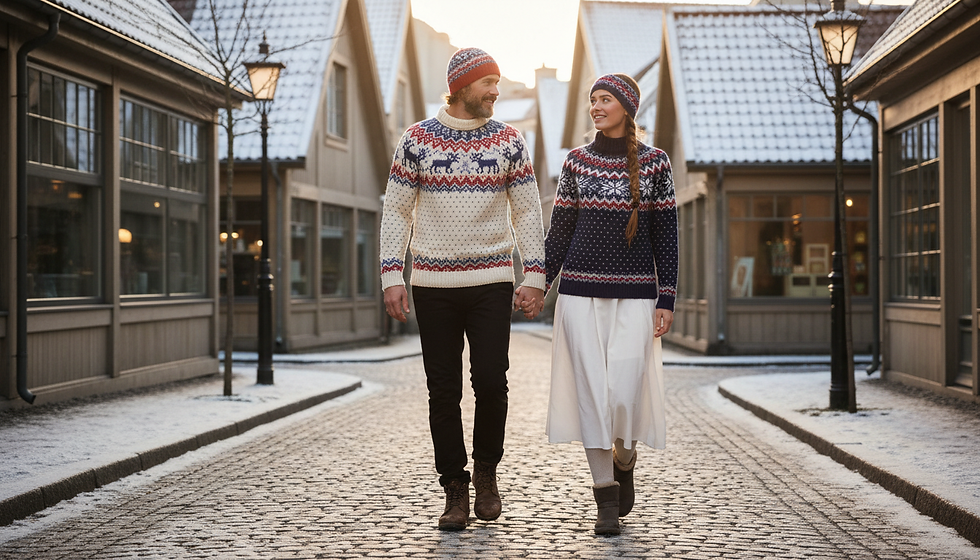
Nordic sweaters developed across Scandinavia (Norway, Iceland, etc.) as winter workwear. They feature symmetrical yoke patterns—snowflakes, stars, folk motifs—knit in thick wool for warmth and moisture resistance.
The snowflake motif is said to have originated from rose designs. Virgin wool in natural colors is commonly used. Nordic sweaters have resurged as a men’s fashion trend, prized for their weight, warmth, and timeless appeal.

7) 🟦 Mohair Cardigan / Sweater
Made from Angora goat hair, mohair knitwear is luxurious, lightweight, warm, and durable. Brushed finishes enhance its hairy texture.
Mohair sweaters surged in popularity in the late 20th century, notably worn by Kurt Cobain of Nirvana, whose iconic cardigan sparked a trend. Today, brands like Our Legacy reinterpret mohair knitwear as luxury fashion, with strong presence in both men’s and women’s markets.


8) 🟩 Commando Sweater
The Commando sweater originated as British military gear. Made of dense wool with reinforced shoulder and elbow patches, it was designed for durability, elasticity, and warmth in harsh outdoor conditions.
Typically dark green, it balanced practicality with functional aesthetics. Later adopted into civilian fashion, it remains a symbol of rugged utility.


9) 🟨 Cosby Sweater
The Cosby sweater, named after comedian Bill Cosby, refers to brightly colored, abstract patterned knitwear popularized in the 1980s–90s through TV and pop culture.
Though not tied to regional tradition, it became iconic in retro fashion. Celebrities like David Beckham also wore them, and today they are reinterpreted as graphic knitwear in modern brands.


Conclusion
Before the Industrial Revolution, clothing was a privilege of the elite, symbolizing wealth and power. With mechanized mass production, garments became accessible to the masses, evolving into tools of self-expression.
Sweaters, once born from necessity in harsh climates, transformed into cultural symbols and fashion staples. Regional traditions (Fair Isle, Aran, Guernsey, Cowichan, Nordic, Shaggy Dog) became brand identities, while modern fashion balances heritage with accessibility.
Today, sweaters coexist in two streams:
Heritage brands preserving craftsmanship and tradition.
Mass-market fashion emphasizing affordability and trendiness.
Both streams enrich the fashion industry, reflecting how clothing evolved from status symbols to expressions of individuality.
In this landscape, Desarang Ltd, based in Guangzhou, China, specializes in women’s sweaters. By offering affordable, trend-driven designs, they make knitwear accessible to diverse consumers while contributing to the global sweater market. Their portfolio includes winter and summer knits, vintage-wash effects, and printed designs, positioning them as a key supplier of mass-market knitwear worldwide.
![[2026 Knitwear Trends] Breaking Design Boundaries: Why 'Desarang Sweater' is Your Essential Partner for Printed & Vintage Knits](https://static.wixstatic.com/media/8eda06_0d721cab6a514db7856a90a7ba9493f3~mv2.png/v1/fill/w_980,h_1225,al_c,q_90,usm_0.66_1.00_0.01,enc_avif,quality_auto/8eda06_0d721cab6a514db7856a90a7ba9493f3~mv2.png)
![[Premium Guide] Summer Knit T-shirts: The Art of Direct Weaving and Production](https://static.wixstatic.com/media/8eda06_c4a41e7efcbe48d0ba799a64d4ab5256~mv2.jpg/v1/fill/w_980,h_1742,al_c,q_85,usm_0.66_1.00_0.01,enc_avif,quality_auto/8eda06_c4a41e7efcbe48d0ba799a64d4ab5256~mv2.jpg)

Comments